
Disaster and Climate-Induced Migration in Bangladesh: A Potential Threat to Human Security
Bangladesh is a disaster-prone nation, and the effects of climate change contribute to more frequent disasters that have an influence on all facets of human existence. According to statistical evidence, Bangladesh, which has a population of 165 million, is extremely vulnerable to climate change and sea level rise. As a result of calamity, people will migrate from one climate zone to another in order to survive and continue to exist. Some migration waves have been linked to cultural collapse because people's once-familiar homes and means of subsistence were no longer provided by those environments.
People have traditionally used migration as a customary response or survival strategy when faced with the possibility, severity, or aftereffects of disasters, whether it be temporary or permanent. Disaster-related migration has the potential to grow to unprecedented proportions and dimensions. On the other hand, frequent disaster events and climate change lead to new forms of vulnerability, such as unsettling movement and immobility, which could endanger human security. Unquestionably, one of the ways that climate change affects people is through comprehensive experiences of insecurity, such as ongoing social marginalisation and precarity.
The theories and metrics employed to measure human security consider these experiences. Almost all facets of human security, in addition to political and state security, could be significantly impacted by its effects on the economy, development, and national budgets. The human core is captured in the components of human security, along with sets of resources and social infrastructure that define their stability and distribution, in the social-ecological systems of migration source and migration destination regions. Environmental change, including climate change, poses a new challenge to social cohesion today and changes the migration landscape. Urban and rural areas will both experience more frequent and dangerous hazard events as a result of climate change.
Bangladesh is more vulnerable and sensitive to many natural and climate-related calamities due to its geographic location and low-lying features. Disaster-related migration has developed into a significant epidemic and could endanger the security of Bangladesh's population. According to the Internal Displacement Monitoring Centre, during the past ten years, natural catastrophes have displaced roughly 110,000 people from Bangladesh annually on average. Internal migration occasionally threatens social harmony and causes conflict in society. In Bangladesh, it is common to experience both natural and man-made hazards, including floods, cyclones, droughts, tidal surges, tornadoes, earthquakes, river erosion, fire, infrastructure collapse, high groundwater arsenic contents, water logging, water and soil salinity, epidemics, and various types of pollution.
Community risk and vulnerability take on a new dimension as a result of climate change. Although these changes may not seem to have a significant impact, they could significantly increase the frequency and intensity of current climate disasters. There are currently signs that floods and cyclones will not only get worse but also start happening outside of their "established seasons." Events like drought may not have previously happened in some places, but may now.
Although Dhaka, the capital of Bangladesh, is thought of as the region's centre of economic opportunity, it is also rife with concerns such as extreme poverty, threats to public health, human trafficking, and other dangers like its own susceptibility to flooding. According to statistical evidence, Dhaka receives about 400,000 low-income migrants each year. Livelihood systems are severely impacted by flooding, severe storms, droughts, or more gradual but equally significant changes in the area's climate. For individuals with the means to leave early and far enough away from danger, migration might be a means of adaptation. Migration, however, may be a sign of a failed adaptation in extreme circumstances and for persons with limited mobility—a desperate attempt to flee pain or even certain death.
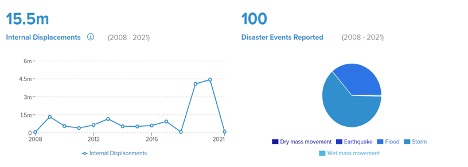
Source: Internal Displacement Monitoring Centre (IDMC)
The effects of global warming on Bangladesh are costly. In Bangladesh, the average annual cost of tropical cyclones is around $1 billion. One third of agricultural GDP could be lost by 2050 as a result of climate variability and extreme events, a horrifying statistic given that agriculture accounts for more than half of the nation's jobs. In the next 30 years, 13.3 million people may become internal migrants due to the consequences of climate change on agriculture, water scarcity, and rising sea levels, with women disproportionately impacted. In the event of severe flooding, the GDP might fall by as much as 9 percent. The rising costs of environmental degradation and natural disasters are projected to be worsened by rising temperatures, humidity, and negative health effects.
Planning for development, raising social awareness, taking part in government initiatives, working with NGOs as development partners, disaster preparedness, and judicial and extrajudicial performance all reflect the quality of governance in Bangladesh. As a result, disaster-related migrants, who are a marginalised group in society, are all but denied access to political benefits. The Bangladeshi government oversees addressing local issues including natural disasters, poverty, ageing, widowhood, vulnerability, illness, unemployment, workplace injuries, disability, etc. by offering several forms of aid such as social services and social support.
However, the government's service delivery agencies primarily deal with ongoing issues. As a result, it has not been able to establish itself as an institution that can effectively provide social services and aid. Additionally, the government's social security activities fall short of meeting the current social needs, leaving fewer benefits for catastrophe victims or refugees brought about by disasters. Climate action over the medium term in Bangladesh will require a minimum of $12.5 billion, or around 3 per cent of GDP.
People, especially migrants and disaster victims, are struggling as a result of unemployment, health risks, population expansion, and exorbitant prices for necessities. One of the deciding elements for potential migrants' future is their ability to make a living in a particular climate and location. What intensifying environmental factors affect migration is a mystery. Environmental change has an impact on livelihoods, particularly in rural areas. In addition, socioeconomic conventions impede development initiatives in which women participate, and the challenges of a changing environment make them even more vulnerable.
Slum settlements in Dhaka are a visible representation of displaced people. People may be less susceptible to disasters if they have access to resources and information. The impoverished have lower levels of knowledge and less access to information, which affects their capacity to deal with crises. Researchers have looked examined whether residents of disaster-prone areas have access to facilities despite their lack of resources and unstable employment.
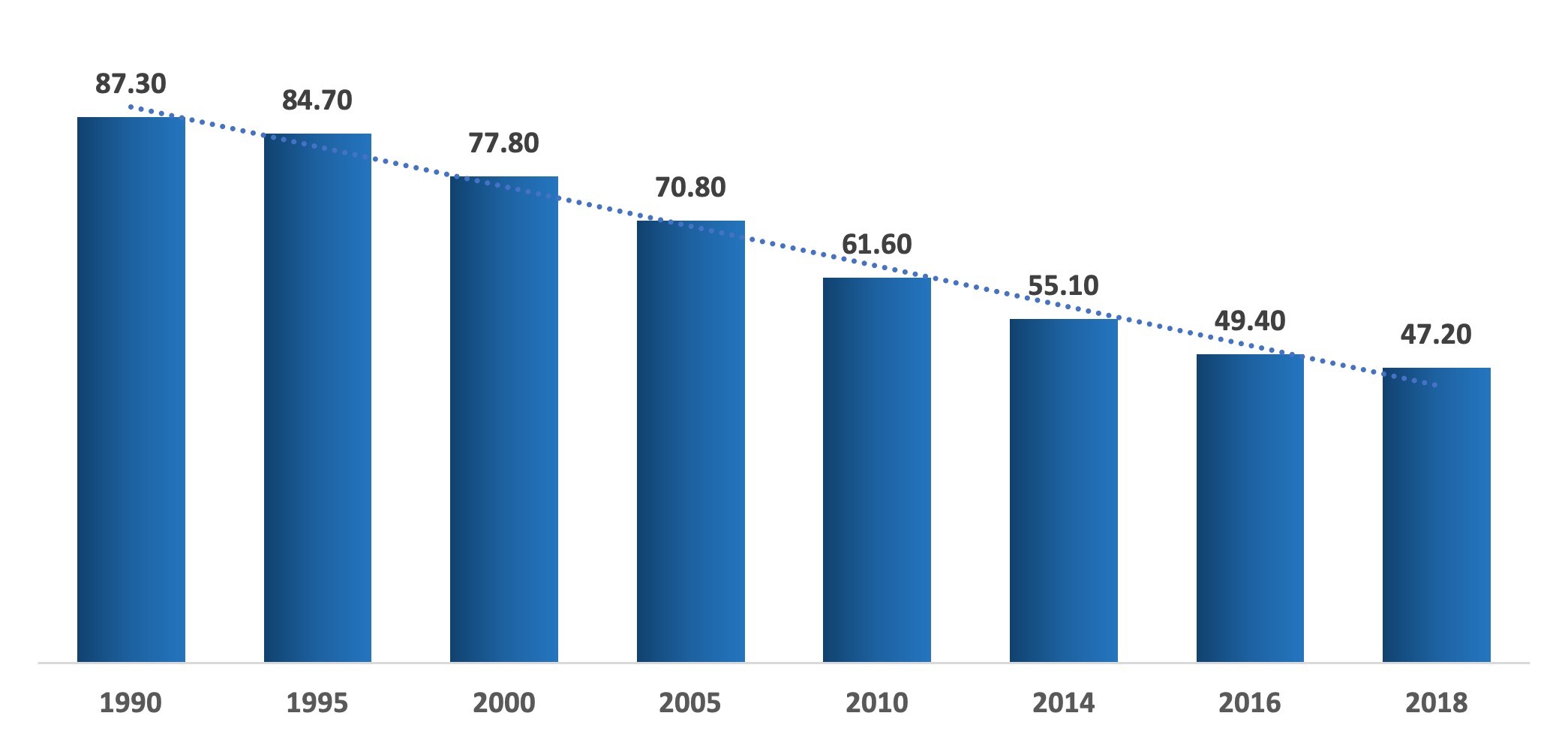
In Dhaka city's slums and squatter settlements, more than 3 million people reside with scant access to utilities. The low-income segment of people in Dhaka city is housed in slums and squatter settlements. Conflict (quarrel, clash, brawl) among squatters and residents of slums is a common occurrence. Noise and violence are produced as a result, disturbing city inhabitants, especially those who live nearby, as well as office employees and schoolchildren. In addition, a significant portion of slum dwellers engages in prostitution, drug trafficking, hijacking, mugging, etc. The social and cultural environments of the city are at risk from these actions. Additionally, the term "social conflict" refers to many forms of unfavourable social interaction, which can involve physical violence, that can take place inside social interactions.
Source: World Bank
There are flaws and inefficiency in Bangladesh's response to natural catastrophes, as seen in the most recent cyclonic storms in its coastal areas. Even after more than a year, the Bangladeshi government was unable to fix the damaged embankments in the hardest-hit regions. People had been uprooted from their houses in great numbers. For the displaced population, there were no suitable rehabilitation programmes. The implementation and oversight of response and rehabilitation programmes also lack accountability and transparency. During the recent natural disasters in Bangladesh, there have been several reports of the local disaster management officials' ineptitude and corruption in the relief and recovery efforts.
The relocation and resettlement of impacted populations are already on the government of Bangladesh's agenda. It is crucial to investigate how shifting environmental conditions influence people's decisions to migrate as the need for discovering suitable adaption pathways for climate change grows increasingly pressing. To ease the path forward and avoid tensions over natural and social resources, to minimise the conflict potential or even possible conflict around migration, a new degree of governmental and scientific attention to this subject is required. In addition, the government must assume responsibility for providing social security for the migrant population living in slums so that they can coexist peacefully and prevent social upheaval.
A framework for acknowledging disaster and climate-induced migrants is required, maybe in a separate convention or in specific provisions of intergovernmental environmental treaties. The Bangladeshi government must take appropriate action to formalize the situation and create a legal framework so that the migrant community can achieve human security. To improve the city's atmosphere generally by reducing anti-social activity, the government should enforce law and order.
The need to provide aid to disaster and climate change displaced people, climate migrants, and environmental refugees must be brought to the attention of the pertinent United Nations agencies and other significant humanitarian assistance organizations, especially when considering the uprooting of entire communities. The easiest way to accomplish this is if there is a global mechanism in place that recognises this group of people. The government of Bangladesh must understand the need of using strong diplomacy while negotiating with its international counterparts.
To be able to support the flux of forced climate migrants at the international and national levels, institutions must be strengthened or created, and the idea of catastrophe and climate-induced migration must be developed. At the national level, this could entail bolstering and encouraging various ministries to collaborate (such as the Ministries of Home Affairs, Environment and Forest, Social Welfare, and Disaster Management, among others) in order to address the problem jointly and incorporate a multidimensional array of competencies and viewpoints. To help structure aid responses, particularly community relocation, a greater knowledge of the social and economic losses people go through is also necessary.
To promote secure, lawful, and orderly migration relations, institutions in the sending and receiving nations should cooperate. To stop migration from the afflicted areas after a disaster, a proper rehabilitation plan is required. A rehabilitation programme should be started as soon as possible following a disaster so that those impacted can rebuild their lives and means of subsistence with confidence. Above all, the Government of Bangladesh's social safety net programme needs to be expanded to include catastrophe victims who have moved to urban regions, and the law-and-order situation in the slum area needs to be adequately managed to avoid social unrest and to protect their human security.
Universities, research institutions, and the Bangladesh Bureau of Statistics could all play a significant part in developing a solid scientific foundation to ensure that the trend of disaster-induced migration is successfully continued. The issue's environmental, social, economic, and political components must be brought to the attention of the general public and government leaders. The government should proceed with raising awareness among the appropriate parties in collaboration with the media in order to provide a solid platform on which everyone can unite to tackle the issues. Civil societies have a crucial role in raising societal consciousness.
The Government of Bangladesh has duly taken the necessary legislative measures to address catastrophe and climate-induced migration, including the mainstreaming of DRR into governance and development. The level of enforcement, however, falls short of expectations. the variety of opportunities and challenges at the national level for addressing the migration caused by disaster with effective measures. It is commonly recognised that well-placed, high-level political commitment combined with pertinent knowledge and expertise can play a significant role in mainstreaming catastrophe resilience into Bangladesh's overall development. The national government's political commitment to advancing disaster risk reduction is high, as seen by the results, and the ongoing push for action has to be strengthened.
By Mohammad Tarikul Islam, Visiting Scientist, Harvard Humanitarian Initiative, and Visiting Professor at Oxford, Cambridge, and Harvard.