
How can research support community resilience? 10 impact lessons over 10 years of programming in Asia

(Part 1 of 3)
By HHI Resilient Communities
Over the past decade, the HHI Resilient Communities Program (HHI RC) has helped transform the landscape of disaster and climate resilience in vulnerable countries where it served—the Philippines, Bangladesh, and Nepal. By weaving rigorous research with cross-sector collaboration, convening, community partnership, policy integration, innovative tool development, and strategic communications, HHI RC has generated actionable knowledge and lasting impact.
In this three-part blog, we share ten key lessons we have learned from ten years of programming—demonstrating how research, convening, engagement, and translation of evidence into action can cultivate more resilient and thriving communities. To start, we spotlight four notable learnings about how the data and evidence generated by our research impact local resilience programming.
1. Population-based data is crucial in resilience building.
Population-based research offers robust, representative findings on different factors and dimensions of resilience in communities. Without timely, accurate information and a holistic understanding of people's strengths, vulnerabilities, risks, behaviors, and preparedness to hazards, resilience actors lack the evidence for developing effective strategies and implementing impactful actions.
What we did:
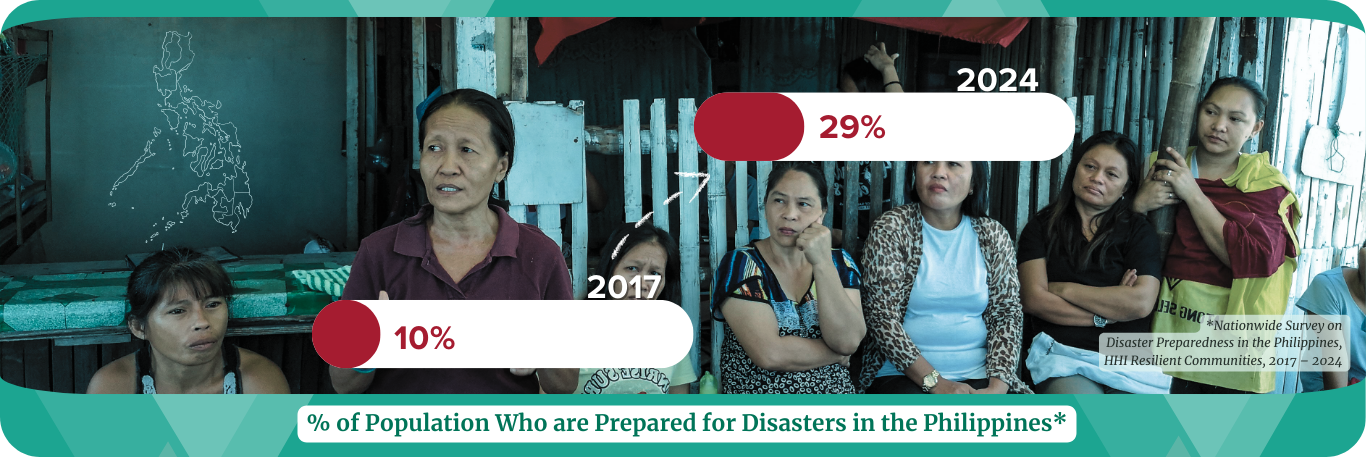
By conducting a first-of-its-kind nationwide household survey on disaster preparedness and resilience in the Philippines in 2017, HHI RC established clear standards of measuring resilience and disaster readiness, and provided comprehensive baseline data. We undertook another nationwide household survey in 2024, along with several granular surveys conducted between 2017 and 2024.
Our Impact:
This approach has helped track changes in disaster and climate resilience—showing that preparedness rates have tripled since 2017 and provided 15 million more people in the Philippines with the tools, knowledge, and confidence to respond, recover, and adapt. It has enabled programs, policies, and resources to be better targeted where they are needed most, empowering both households and governments to act on evidence, not assumptions.
Local Insights:
"The Philippines has made significant strides in disaster preparedness. This was revealed by a recent survey from the Harvard Humanitarian Initiative (HHI) ... Through collaborative research, information sharing, and innovative financing, we continue to strengthen and deepen our partnerships with these key stakeholders."
- Office of the President of the Philippines, President Ferdinand R. Marcos Jr.
2. Accurate data and evidence can shape the direction of humanitarian aid.
Comprehensive research that generates accurate data and evidence provides the foundation for smarter, faster, and more effective humanitarian responses.
What we did:
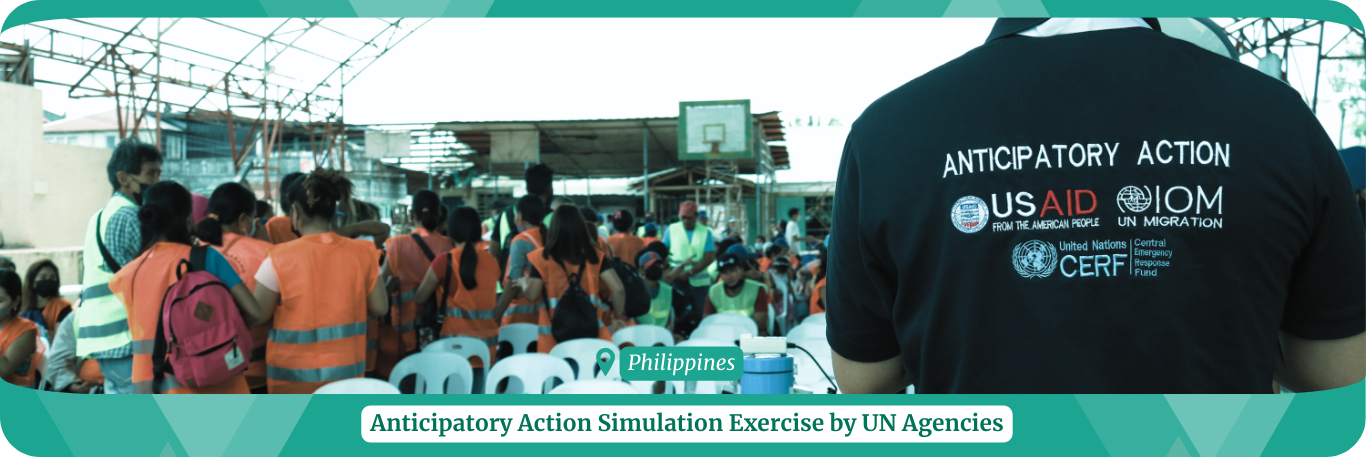
HHI RC generated data and analysis to inform aid agencies' needs assessments, policy dialogues, and funding strategies, including those related to early warning and pre-disaster cash programming. We partnered with national and international actors to ensure that findings informed anticipatory action programs (AA). We developed and tested tools to track change and evaluate impact across projects and geographies.
Our Impact:
HHI RC's contributions informed more than $100 million in humanitarian aid, disaster risk reduction, and anticipatory action, helping guide where, when, and how aid is delivered. We helped shape program design grounded in community perceptions and real-world constraints, and supported the integration of evaluation tools into planning by humanitarian agencies, researchers, and local governments. Furthermore, we contributed to the shift from reactive response to evidence-based early action, with data now being used in national frameworks and international guidance documents.
Local Insights:
“[HHI's] participatory research is extremely important in resilience building because resilience activities and intervention measures should be community-led... In DRR, we must have scientific knowledge, but community members must also understand it. Science should converge with local and Indigenous knowledge and perceptions.”
- Maria Felizar-Cagay, Program Manager of Advocacy, Training, and Influencing, Center for Disaster Preparedness (CDP) Foundation
3. Communities take ownership when tools and research are co-created with them.
When communities are actively engaged in designing research tools and resilience plans, local ownership and uptake increase. Co-creation in research ensures interventions are locally grounded, culturally relevant, and sustainable. Community-driven planning strengthens confidence, capacity, and the will to act—making resilience a shared achievement, not an external mandate for at-risk populations.

What we did:
In Nepal, we partnered with women-led community organizations and supported a participatory evaluation process to understand barriers and opportunities for women's leadership in resilience governance. In the Philippines, HHI RC facilitated a series of community workshops to develop a locally owned community-based disaster risk reduction and management plan (CBDRRM) in a disaster-prone coastal community.
Our Impact:
In Nepal, women-led groups were empowered to collect and evaluate their own data, reinforcing ownership, voice, and evidence-informed local advocacy. Findings from the evaluation are now used to design and deliver climate leadership training sessions for women community leaders, enhancing their capacity in climate awareness, adaptation strategies, and gender-inclusive planning. In the Philippines, participatory research and co-creation strengthened local capacity for early warning, evacuation planning, and coordination with local government, turning risk awareness into practical action. The initiative demonstrated a model of co-created, evidence-informed disaster planning that other coastal and high-risk communities across the region can adopt.
Local Insights:
"Our community here in Pugad Island is routinely hit by flooding and typhoons. There was even a time when many houses had been totally wiped out after a strong typhoon. That's why we value the importance of research and support for small communities like ours. So, we made sure to welcome and work together with researchers like HHI whenever they want to help us improve our preparedness for disasters. We are honored and grateful to have collaborated with them."
- A resident of a coastal community, Pugad Island, in the Philippines
4. Examining under-researched topics can attract attention and action on unaddressed issues.
Research can spotlight overlooked resilience challenges by generating new data and analysis, and raising public awareness. By addressing knowledge gaps, research can bring visibility and urgency to issues often excluded in mainstream resilience programming and influence policies and inclusive solutions.

What we did:
HHI RC examined under-researched issues in resilience, such as mental health, disability, and the climate-conflict nexus. We partnered with local professional associations, humanitarian and development organizations, government agencies, and local communities to generate evidence grounded in real-time, local experiences. Moreover, we took a closer look at the connection between climate change and these unaddressed issues by integrating specific questions into broader resilience and disaster preparedness surveys, research, and expert dialogues.
Our Impact:
HHI RC helped bring mental health into resilience discourse, influencing how preparedness, wellbeing, and psychosocial support are addressed in disaster planning. We strengthened partnerships with national mental health stakeholders and advocacy groups. We brought attention to previously siloed issues, helping local humanitarians, development actors, and government realize the overlap between environmental degradation, climate change, conflict, and social instability.
Local Insights:
"The findings from HHI's research gave us critical insight into the needs of mental health providers during the pandemic. As HHI turned its focus to climate change and mental health, this work became even more essential, especially for the marginalized communities most affected."
- Dr. Antonio C. Sison, President, Philippine Psychiatric Association (2022)
These first four impact lessons demonstrate the transformative power of resilience research in driving local change. By grounding resilience programming in population-based data, co-created tools, and inclusive inquiry, we can help communities and decision-makers act effectively on pressing needs and emerging challenges. As we continue our journey, these learnings reaffirm that resilience research is not just about generating knowledge—it is about empowering people and leaders, influencing policy, and translating evidence into impactful actions for communities to thrive in the face of climate change and disasters.
Read the next parts of this blog series:
Part 2
How can communication support community resilience?

At HHI Resilient Communities, communications have always been an integral element of our research work. In this second part of our blog series, we share the top three lessons from our impactful communications initiatives in the Philippines, Bangladesh, and Nepal over the past decade... Read more
Part 3
How can collaboration support community resilience?

At HHI Resilient Communities, we believe solutions are most effective when developed together with local partners. Over the past decade, we catalyzed cross-sector coordination and collaboration with dozens of local partners in the Philippines, Bangladesh, and Nepal to co-create research, resilience tools, and action plans. In this last part of our blog series, we discuss three takeaways from our collaboration initiatives, which complete our top ten impact lessons over our ten years of programming in Asia... Read more